Buying a Car in Japan as a US Navy Member
Buying and registering a car in Japan can be confusing for US Navy members because the normal Japanese registration process is different from the process used by personnel stationed in Japan under the Status of Forces Agreement, commonly known as SOFA.
One of the biggest questions is whether you can buy and register a Japanese car without a Japanese Residence Card or Juminhyo. In many cases, US military personnel stationed in Japan under SOFA can register a privately owned vehicle using their military identification and proof of SOFA status instead of the standard Japanese resident registration documents.
However, the exact procedure can vary depending on your base, location, vehicle type, housing situation, and whether you are buying from a Japanese dealer, a private seller, or another SOFA member.
This guide explains the important terms, documents, and general process you should understand before purchasing a car.
What Is Shaken?
Shaken, or 自動車検査登録制度 and 自動車検査, is Japan's mandatory vehicle inspection system. It checks whether a vehicle meets Japanese safety and regulatory requirements.
Shaken is not simply a regular maintenance service. It is an official inspection required for vehicles operated on public roads.
During the inspection process, items such as brakes, lights, steering, tires, emissions and other safety related components are checked. The vehicle must satisfy the applicable Japanese requirements before the inspection can be completed.
The inspection period depends on the vehicle and its registration history. For a typical privately owned passenger car, the first inspection after a new vehicle registration is generally three years, followed by inspections at regular two year intervals.
When buying a used car, always check the exact Shaken expiration date shown on the vehicle documents rather than assuming how long remains.
What Is JCI?
JCI means Japanese Compulsory Automobile Liability Insurance, or 自動車損害賠償責任保険.
JCI is compulsory insurance required for vehicles in Japan. It provides legally required liability coverage for bodily injury caused by a motor vehicle accident.
JCI is different from private or additional liability insurance. US Forces personnel are also required to maintain the applicable additional liability or property damage insurance required by their installation and USFJ rules.
The Commander Fleet Activities Yokosuka Vehicle Registration Office specifically explains that JCI and the compulsory vehicle inspection are separate requirements, even though people sometimes informally refer to the combination as “JCI inspection.”
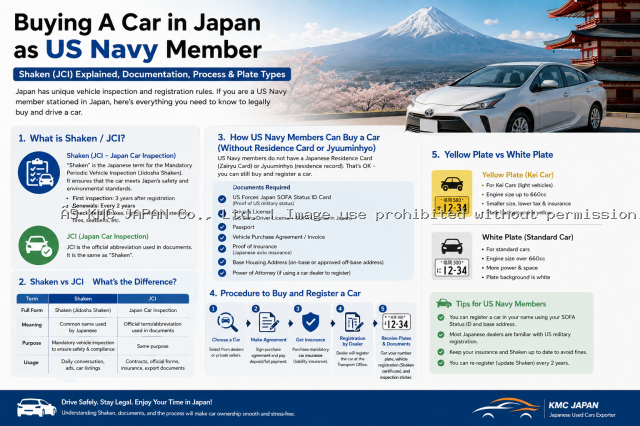
Shaken vs JCI: What Is the Difference?
| Item | Shaken | JCI |
|---|---|---|
| Japanese name | 自動車検査 | 自賠責保険 |
| Meaning | Mandatory vehicle inspection | Compulsory automobile liability insurance |
| Main purpose | Checks vehicle safety and regulatory compliance | Provides compulsory liability coverage for bodily injury |
| Insurance? | No | Yes |
| Required for normal road use? | Yes, when inspection is due | Yes |
In simple terms: Shaken checks the car. JCI provides compulsory insurance coverage. You normally need both.
Can a US Navy Member Buy a Car Without a Residence Card or Juminhyo?
Yes, US military personnel stationed in Japan under SOFA may be able to purchase and register a vehicle without a Japanese Residence Card or Juminhyo.
US military members have a special status in Japan. The Japanese Embassy confirms that members of the US armed forces stationed at a US base in Japan are handled under the SOFA framework and do not follow the normal Japanese visa and residence registration process.
Because of this, vehicle registration procedures for SOFA personnel use military documentation and USFJ registration procedures. The exact documents required can differ between installations.
For example, the Navy Vehicle Registration Office at Sasebo lists proof of SOFA status, a USFJ Form 4EJ POV permit, Japanese vehicle title, JCI, liability insurance, road tax documentation and proof of an approved parking space or Japanese parking certificate among the requirements for vehicle registration.
Therefore, not having a Residence Card or Juminhyo does not automatically prevent a US Navy member from owning a car in Japan.
Documents Usually Required for a US Navy Member
The exact checklist should always be confirmed with your local Vehicle Registration Office before completing the purchase. Depending on the installation and vehicle, you may need:
- US military ID or DoD ID card
- Proof of SOFA status
- USFJ Form 4EJ, the Japan based US Forces driver's permit
- Japanese vehicle title
- Bill of Sale or Jyoto Shomei Sho
- Current JCI certificate
- Private liability insurance certificate
- Current Japanese road tax documentation, when applicable
- Parking certificate or approved parking documentation, when required
- Vehicle inspection documentation
- Power of Attorney, if another person is completing the transaction on your behalf
For example, the Sasebo Navy Vehicle Registration Office specifically lists proof of SOFA status, USFJ Form 4EJ, Japanese title, JCI, liability insurance, road tax and approved parking documentation.
At Yokosuka, the published procedure for purchasing a vehicle without plates also requires proof of USFJ personnel status, a valid USFJ driver's license, a parking certificate where applicable, title, bill of sale, JCI and liability insurance.
USFJ Form 4EJ: Your Japan Driving Permit
A US Navy member normally needs a valid USFJ Form 4EJ, commonly called the SOFA driver's license or SOFA operator's permit, to drive a vehicle in Japan.
For example, Commander Fleet Activities Yokosuka states that the USFJ Form 4EJ is required for personnel to operate a vehicle in Japan. The qualification process can include local driving requirements, testing and an approved underlying driver's license or other qualifying credential.
You should obtain the appropriate USFJ driving authorization before planning to drive your newly purchased vehicle.
Step by Step: How to Buy a Car in Japan as a US Navy Member
Step 1: Choose Your Car
You can purchase a vehicle from a Japanese used car dealer, private seller or another SOFA member.
Before paying, check:
- Vehicle registration certificate
- Current Shaken expiration date
- Current JCI
- Road tax status
- Recycling fee documentation
- Vehicle mileage and condition
- Accident or repair history where available
- Number of previous owners
- Parking requirements
Step 2: Confirm Your Eligibility With Your VRO
Before signing the final purchase agreement, contact the Vehicle Registration Office at your installation.
This is especially important if you are purchasing your first vehicle, a second vehicle, a yellow plate Kei car, or a vehicle without current plates.
Some installations may also have restrictions or additional command approval requirements depending on rank, number of vehicles and other circumstances. Published Yokosuka guidance, for example, has specific requirements for certain personnel purchasing a vehicle without plates.
Step 3: Obtain the Purchase Documents
Ask the dealer or seller for the required ownership documents, including the Japanese title and bill of sale or transfer document.
If another person will complete the registration for you, an appropriate original Power of Attorney may be required. Some US military installations specifically require an original POA rather than a photocopy or electronic copy.
Step 4: Arrange Insurance
Make sure the vehicle has valid JCI and the required additional liability insurance before registration and operation.
US Forces Japan requirements can include minimum additional liability or property damage coverage. For example, MilitaryINSTALLATIONS guidance for US Forces personnel states that liability insurance is required and lists minimum coverage requirements.
Step 5: Complete the Japanese Registration
Depending on the vehicle, you may need to visit the appropriate Land Transportation Office or Light Motor Vehicle Office.
The registration process can include ownership transfer, inspection, payment of applicable taxes and fees, issuance of registration documents and number plates.
For a vehicle without plates, temporary plates may be required so that the vehicle can legally travel to the inspection and registration locations. Published US military procedures describe this process for vehicles purchased from Japanese sources without plates.
Step 6: Complete US Military Registration
After the Japanese registration requirements are completed, the vehicle normally also needs to be registered with the appropriate US military Vehicle Registration Office or security office.
US Forces guidance states that privately owned vehicles operated by US military personnel in Japan must be registered through the applicable Japanese and military authorities.
What If You Live Off Base?
Living off base does not necessarily prevent you from owning a vehicle. However, your housing and parking documentation may become important.
Depending on the location of your residence and the installation rules, you may need to provide a housing rental agreement or obtain a Japanese parking certificate, commonly called a Shako Shomeisho.
For example, Camp Zama guidance states that personnel living off post may need a parking certificate depending on the distance from the installation and location of the parking space.
Because parking rules vary, check with your local VRO before buying the vehicle.
Yellow Plate vs White Plate Cars in Japan
Japanese vehicles are commonly divided into Kei cars and standard passenger vehicles. The plate color is one of the easiest ways to distinguish them.
Yellow Plate: Kei Car
A yellow plate generally identifies a Kei car, known in Japanese as 軽自動車.
Kei cars are small vehicles that meet Japan's Kei vehicle specifications. Passenger Kei cars have engines up to 660cc and are generally smaller and less expensive to operate than standard cars.
Popular examples include the Suzuki Wagon R, Suzuki Alto, Daihatsu Mira, Daihatsu Tanto, Honda N-Box and similar models.
Advantages can include:
- Small and easy to drive
- Good fuel economy
- Lower vehicle related taxes than many standard cars
- Often lower ownership costs
- Easy to park in smaller spaces
However, a Kei car is not necessarily the best choice for every driver. Highway driving, passenger capacity, cargo requirements and long distance travel should be considered before purchasing.
White Plate: Standard Car
A white plate generally identifies a standard passenger vehicle rather than a Kei car.
Standard cars are available with engines larger than 660cc and come in many sizes and categories, including compact cars, sedans, SUVs, minivans and hybrids.
Advantages can include:
- More engine power
- More space and passenger capacity
- Better suitability for long distance driving
- More choices of hybrid, SUV and family vehicles
Taxes, insurance, fuel consumption and other ownership costs can be higher than for a Kei car depending on the vehicle.
Important: Do Not Confuse Japanese Plate Color With US Military Plates
US military vehicles in Japan can be subject to special registration and plate procedures. Military registration requirements can differ from the normal Japanese civilian vehicle process.
For this reason, a US Navy member should not assume that every vehicle purchased through a Japanese dealer will follow exactly the same plate procedure as a normal Japanese civilian buyer.
Your local VRO can confirm the correct plate and registration procedure for your installation and vehicle.
How Much Does It Cost to Register a Car?
The total cost depends heavily on the vehicle and its current Shaken status.
Potential costs can include:
- Vehicle purchase price
- JCI
- Additional liability insurance
- Shaken inspection and maintenance
- Weight tax
- Registration fees
- Road tax
- Number plate fees
- Parking certificate fees, where required
- Recycling fee
- Dealer registration or administrative fees
Do not judge a used car only by its purchase price. A car with a lower purchase price but an expired Shaken can require substantially more money before it is ready for regular road use.
Buying a Car With Existing Shaken
For many buyers, a vehicle with remaining Shaken can be more convenient because the vehicle has already passed its current inspection and can generally be transferred and operated subject to the applicable registration, insurance and tax requirements.
Always verify:
- Exact Shaken expiration date
- JCI expiration date
- Road tax status
- Vehicle title
- Any outstanding registration requirements
- Whether the vehicle requires additional inspection before military registration
Can a US Navy Member Buy a Used Kei Car?
Yes. A US Navy member who meets the applicable USFJ and installation requirements can generally purchase a Kei car, subject to the same registration and insurance requirements applicable to the vehicle.
Kei cars can be particularly attractive for personnel who want an inexpensive vehicle for commuting, shopping and short trips.
Before purchasing, however, confirm the parking requirements for the specific vehicle and your installation.
Can a US Navy Member Buy a Hybrid or Large Car?
Yes. SOFA personnel may purchase different types of privately owned vehicles subject to applicable registration requirements.
For a larger car, remember to consider vehicle taxes, fuel costs, insurance, parking space and maintenance. A compact hybrid can sometimes provide a good balance between fuel economy, passenger space and highway performance.
What Should You Check Before Paying the Dealer?
Before making the final payment, ask the dealer to confirm the following:
- Is the vehicle currently registered?
- When does Shaken expire?
- When does JCI expire?
- Is road tax paid?
- Is the recycling fee already paid?
- Is the original Japanese title available?
- Is the vehicle eligible for SOFA registration?
- Are any additional inspections required by the installation?
- Does the vehicle require a parking certificate?
- Can the dealer assist with LTO and VRO registration?
Final Checklist for US Navy Car Buyers in Japan
- Have a valid USFJ Form 4EJ
- Carry your military ID and proof of SOFA status
- Choose the vehicle and verify its documents
- Confirm Shaken expiration
- Confirm JCI expiration
- Arrange required liability insurance
- Confirm parking requirements
- Obtain the Japanese title and transfer documents
- Complete Japanese registration and inspection requirements
- Obtain the correct number plates
- Complete registration with your installation VRO
- Keep all vehicle, insurance and registration documents safely
Conclusion
Buying a used car in Japan as a US Navy member is possible even though SOFA personnel generally do not have the same Japanese Residence Card and Juminhyo documentation used by ordinary Japanese residents.
The key is to follow the USFJ and installation Vehicle Registration Office procedure in addition to the Japanese vehicle registration requirements.
Remember the most important distinction: Shaken is the vehicle inspection, while JCI is compulsory automobile liability insurance. You normally need both, along with the additional insurance required for US Forces personnel.
Whether you choose a yellow plate Kei car or a white plate standard car, checking the vehicle documents and confirming the registration procedure with your local VRO before payment can save you significant time and unexpected costs.
Important: Vehicle registration procedures can differ between US military installations in Japan. Requirements may also change. Always confirm the current requirements with your local Vehicle Registration Office before purchasing or registering a vehicle.
Sources and Official References
US Navy and US Forces Japan vehicle registration guidance should be treated as the primary reference for SOFA personnel. Published guidance from Commander Fleet Activities Sasebo, Commander Fleet Activities Yokosuka, Camp Zama and other US military installations provides installation specific requirements.