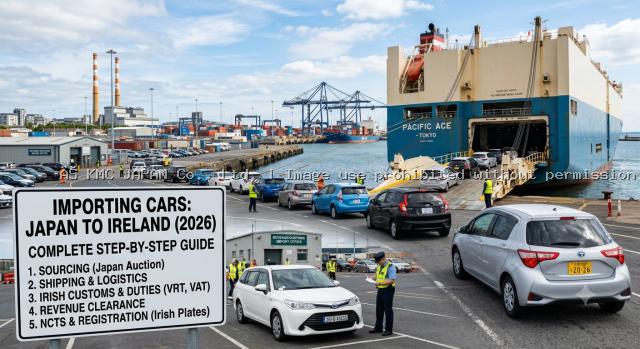
Importing Cars from Japan to Ireland (2026): Complete Step-by-Step Guide
Ireland has become one of the fastest-growing markets for imported Japanese vehicles. Buyers appreciate Japanese cars for their outstanding reliability, low mileage, excellent maintenance history, and competitive pricing. Whether you're looking for a fuel-efficient hybrid, a practical family SUV, a performance car, or a classic Japanese model, importing directly from Japan can provide excellent value.
However, importing a vehicle into Ireland involves more than simply purchasing a car. You must understand customs procedures, taxes, shipping options, Vehicle Registration Tax (VRT), documentation requirements, and vehicle registration rules before your vehicle can legally be driven on Irish roads.
This complete 2026 guide explains every stage of the process, helping first-time buyers and experienced importers make informed decisions.
Why Import a Car from Japan?
Japan has one of the world's largest used vehicle markets. Strict vehicle inspections, excellent road conditions, and careful ownership standards mean many used vehicles remain in outstanding condition even after several years of use.
Main Advantages
- Excellent overall vehicle condition
- Lower average mileage compared to many European vehicles
- Regular servicing and maintenance
- Large selection of hybrid vehicles
- Competitive purchase prices
- Access to models unavailable in Europe
- Reliable auction grading system
- Wide choice of commercial vehicles and kei cars
Can You Import a Japanese Car into Ireland?
Yes. Ireland allows the importation of vehicles from Japan provided the importer follows all customs, taxation, and registration requirements.
After arriving in Ireland, imported vehicles generally must:
- Complete customs clearance.
- Pay applicable customs duties and taxes.
- Be registered with Revenue through the National Car Testing Service (NCTS).
- Pay Vehicle Registration Tax (VRT).
- Meet Irish roadworthiness requirements.
- Obtain Irish registration plates before being driven on public roads.
Step 1: Choose the Right Vehicle
The first step is selecting a vehicle that suits your needs and budget. Many Irish buyers source vehicles through Japanese auto auctions because they offer the widest selection and transparent inspection reports.
Popular Japanese Imports in Ireland
| Vehicle Type | Popular Models |
|---|---|
| Hybrid Cars | Toyota Prius, Toyota Aqua, Honda Fit Hybrid |
| SUVs | Toyota Land Cruiser, Subaru Forester, Nissan X-Trail |
| Family Cars | Toyota Corolla, Mazda Axela, Honda Civic |
| Performance Cars | Nissan Skyline GT-R, Toyota Supra, Subaru WRX STI |
| Commercial Vehicles | Toyota HiAce, Nissan Caravan, Isuzu Elf |
Step 2: Buy Through a Trusted Japanese Exporter
Most Japanese vehicle auctions are only open to licensed dealers. Overseas buyers usually purchase vehicles through a licensed exporter such as KMC JAPAN.
A professional exporter can help you:
- Search auction inventory.
- Translate auction sheets.
- Inspect vehicle condition.
- Place bids at auction.
- Arrange inland transportation.
- Prepare export documentation.
- Book international shipping.
Step 3: Choose Your Shipping Method
Vehicles are commonly shipped from Japan using one of two methods.
RoRo (Roll-on/Roll-off)
RoRo is the most economical shipping option for operational vehicles. Cars are driven onto the vessel and secured for transport.
- Lower shipping cost
- Faster loading and unloading
- Ideal for standard passenger vehicles
Container Shipping
Container shipping provides additional protection during transport and is ideal for high-value or classic vehicles.
- Better protection from weather
- Suitable for modified or luxury cars
- Allows spare parts to be shipped with the vehicle
Required Documents
| Document | Purpose |
|---|---|
| Commercial Invoice | Confirms purchase price |
| Bill of Lading | Shipping document issued by carrier |
| Export Certificate | Proof of Japanese deregistration |
| Export Inspection Documents (if applicable) | Country-specific requirements |
| Photo Identification | Importer identification |
| Proof of Address | Required during registration |
| Customs Declaration | Import processing |
Estimated Import Costs
The total cost of importing a vehicle depends on several factors, including the purchase price, shipping charges, customs duties, taxes, and registration fees.
| Expense | Description |
|---|---|
| Vehicle Purchase Price | Winning auction or dealer price |
| Exporter Fee | Service fee charged by exporter |
| Inland Transport | Delivery from auction to port |
| Ocean Freight | Shipping from Japan to Ireland |
| Marine Insurance (Optional) | Protection during shipping |
| Customs Charges | Applicable duties and taxes |
| Vehicle Registration Tax (VRT) | Calculated by Irish Revenue |
| NOx Levy | Applies to many imported vehicles based on nitrogen oxide emissions |
| Registration Costs | Irish registration process |
2026 Import Requirements for Ireland
When importing a vehicle from Japan into Ireland in 2026, importers should be prepared to complete customs clearance, provide the required documentation, register the vehicle through the National Car Testing Service (NCTS) on behalf of Revenue, and pay applicable taxes and charges. Depending on the vehicle and its origin, these may include customs duty, VAT, Vehicle Registration Tax (VRT), and a NOx levy. The amount payable varies based on factors such as the vehicle's customs value, CO₂ emissions, NOx emissions, age, and Revenue's assessed Open Market Selling Price (OMSP).
It is also important to register the vehicle within the timeframe specified by Irish authorities after it enters the State. Before purchasing a vehicle, buyers should verify the latest import requirements and tax calculations with the Irish Revenue Commissioners, as regulations and rates may change.
What's Next?
Now that you understand the basics of importing a vehicle from Japan to Ireland, the next step is learning how customs clearance, VAT, customs duty, Vehicle Registration Tax (VRT), and the NOx levy are calculated. These costs can significantly affect the total price of your imported vehicle.
Step 4: Customs Clearance in Ireland
Once your vehicle arrives at an Irish port, it must complete customs clearance before it can be released. Customs authorities verify the import documentation, determine the customs value of the vehicle, and assess any applicable customs duty and Value-Added Tax (VAT).
The customs value is generally based on the purchase price of the vehicle together with certain transport and insurance costs incurred before the vehicle reaches Ireland. Keep all invoices and shipping documents, as customs officials may request them during the clearance process.
Documents Commonly Required for Customs Clearance
- Commercial Invoice
- Bill of Lading
- Japanese Export Certificate
- Purchase Contract or Sales Invoice
- Photo Identification
- Proof of Payment
- Shipping Documents
- Customs Declaration
Working with an experienced customs broker or your exporter can help ensure the customs process is completed smoothly and efficiently.
Step 5: Understanding Customs Duty
Whether customs duty applies depends on the origin of the vehicle and the applicable trade rules. Vehicles imported from Japan may qualify for preferential tariff treatment when the required proof of origin is available under the EU-Japan Economic Partnership Agreement (EPA). If the conditions are not met, customs duty may still apply.
Before purchasing a vehicle, confirm whether it qualifies for preferential treatment and ensure the necessary origin documentation is available.
Always ask your exporter whether the vehicle qualifies for preferential origin status before shipment. This can reduce your overall import costs.
Step 6: Value-Added Tax (VAT)
VAT may be payable when importing a vehicle from Japan into Ireland. The VAT calculation generally considers the customs value together with any applicable customs duty and other eligible import costs.
The exact amount depends on Irish tax legislation in force at the time of import.
Factors Affecting VAT
- Vehicle purchase price
- Shipping costs
- Marine insurance
- Customs duty (where applicable)
- Customs valuation
Importers should retain all invoices and payment records, as Revenue may request supporting documentation.
Step 7: Vehicle Registration Tax (VRT)
Vehicle Registration Tax (VRT) is one of the most important costs when importing a vehicle into Ireland.
Every imported vehicle must normally be presented for registration through the National Car Testing Service (NCTS), which acts on behalf of Revenue.
The amount of VRT payable depends on several factors, including:
- Vehicle category
- Open Market Selling Price (OMSP)
- CO₂ emissions
- Vehicle age
- Vehicle specifications
The OMSP is determined by Revenue and represents the estimated retail value of the vehicle in the Irish market.
What Is OMSP?
Open Market Selling Price (OMSP) is Revenue's estimate of what the vehicle would reasonably sell for in Ireland, rather than simply the price you paid in Japan.
Because VRT is calculated using the OMSP, two vehicles purchased for similar prices may have different VRT liabilities depending on their Irish market value.
Understanding CO₂ Emissions
Ireland uses CO₂ emissions as one of the key factors when calculating VRT for passenger vehicles.
Vehicles with lower CO₂ emissions generally attract lower VRT than vehicles with higher emissions.
This makes many Japanese hybrid vehicles attractive to Irish buyers because they often produce relatively low emissions.
| Vehicle Type | Typical CO₂ Level | General VRT Impact |
|---|---|---|
| Hybrid | Low | Usually Lower |
| Small Petrol | Moderate | Moderate |
| Large SUV | Higher | Usually Higher |
| Performance Vehicle | High | Often Higher |
NOx Levy Explained
Many imported vehicles are also subject to a Nitrogen Oxides (NOx) levy.
The levy is based on the vehicle's certified NOx emissions and is calculated separately from VRT.
Vehicles with lower NOx emissions generally incur a lower levy, while older diesel vehicles may have significantly higher NOx charges.
Hybrid vehicles often benefit from comparatively lower NOx emissions.
Step 8: Booking Your NCTS Registration Appointment
Once your vehicle has arrived in Ireland, you should arrange a registration inspection through the National Car Testing Service (NCTS).
During the appointment, inspectors verify:
- Vehicle Identification Number (VIN)
- Mileage
- Vehicle category
- Engine size
- Fuel type
- CO₂ emissions
- Supporting documentation
Revenue uses the inspection information when determining the applicable VRT.
Registration Timeline
| Stage | Typical Time |
|---|---|
| Purchase at Auction | 1 Day |
| Transport to Japanese Port | 2–7 Days |
| Export Processing | 3–7 Days |
| Ocean Shipping | 6–10 Weeks (depends on route and schedule) |
| Customs Clearance | 1–5 Days |
| NCTS Registration Appointment | Subject to appointment availability |
| Irish Registration Completed | After payment of applicable taxes and successful processing |
Step 9: Insurance
Before driving your imported vehicle on Irish roads, you must arrange appropriate motor insurance.
Insurance companies may request:
- Vehicle registration details
- Vehicle specifications
- Driving licence
- No Claims Bonus information
- Proof of ownership
It is often helpful to contact insurers before importing a vehicle to confirm they will provide cover for your chosen model.
Step-by-Step Import Process
- Select your preferred vehicle.
- Review the Japanese auction sheet.
- Confirm import eligibility.
- Purchase through KMC JAPAN.
- Arrange payment.
- Book ocean shipping.
- Receive export documents.
- Complete customs clearance in Ireland.
- Book an NCTS registration inspection.
- Pay any applicable VRT, VAT, customs charges, and NOx levy.
- Receive Irish registration.
- Arrange insurance.
- Fit Irish number plates.
- Enjoy your imported Japanese vehicle.
Common Mistakes to Avoid
- Buying a vehicle without checking the auction sheet.
- Ignoring shipping costs when calculating your budget.
- Assuming VRT is based solely on the purchase price.
- Overlooking the NOx levy.
- Failing to keep invoices and payment records.
- Missing registration deadlines.
- Choosing an exporter without verifying their experience.
Money-Saving Tips
- Choose vehicles with lower CO₂ emissions.
- Compare shipping options before booking.
- Purchase vehicles with strong auction grades.
- Request auction sheet translations.
- Consider hybrid models for potentially lower running costs.
- Buy through an experienced exporter such as KMC JAPAN.
Why Import Through KMC JAPAN?
KMC JAPAN provides a complete vehicle export service for customers in Ireland. Our experienced team assists buyers from the moment they begin searching for a vehicle until it arrives at its destination.
Our services include:
- Access to all major Japanese auction houses.
- Professional auction sheet translations.
- Vehicle sourcing and bidding.
- Independent vehicle inspections.
- Competitive shipping arrangements.
- Export documentation.
- Customer support throughout the import process.
By working with an experienced exporter, you reduce the risks associated with international vehicle purchasing and gain access to thousands of quality Japanese vehicles every week.
Example Cost Breakdown for Importing a Car from Japan to Ireland
The total cost of importing a vehicle depends on several factors, including the purchase price, shipping costs, customs valuation, taxes, and registration charges. The example below is for illustration only and should not be considered a quotation.
| Expense | Example |
|---|---|
| Vehicle Purchase Price | €7,500 |
| Exporter Service Fee | €500 |
| Inland Transport in Japan | €180 |
| Ocean Freight | €1,100 |
| Marine Insurance (Optional) | €120 |
| Customs Duty (if applicable) | Varies |
| VAT | Varies |
| Vehicle Registration Tax (VRT) | Varies |
| NOx Levy | Varies |
| Registration Costs | Varies |
Important: The actual amount payable depends on the vehicle's customs value, emissions, Revenue's Open Market Selling Price (OMSP), applicable legislation, and other factors. Always calculate the total import cost before purchasing a vehicle.
Frequently Asked Questions
Can I import a used car from Japan to Ireland?
Yes. Irish residents and businesses can import used vehicles from Japan, provided all customs, taxation, and registration requirements are completed.
How long does shipping from Japan to Ireland take?
Shipping generally takes between 6 and 10 weeks depending on the shipping company, route, vessel schedule, and destination port.
Can I buy directly from a Japanese auction?
No. Most Japanese auto auctions are restricted to licensed dealers. International buyers normally purchase vehicles through a licensed exporter such as KMC JAPAN.
Do I have to pay Vehicle Registration Tax (VRT)?
Most imported vehicles must be registered in Ireland and are generally subject to Vehicle Registration Tax (VRT). The amount depends on Revenue's assessment and the vehicle's specifications.
What documents are required?
- Commercial Invoice
- Bill of Lading
- Japanese Export Certificate
- Proof of Identity
- Proof of Address
- Customs Documentation
- Vehicle Purchase Documents
Are Japanese cars reliable?
Yes. Japanese vehicles are internationally recognised for their reliability, fuel efficiency, build quality, and long service life. Many imported vehicles also benefit from excellent maintenance records and relatively low mileage.
Why Choose KMC JAPAN?
KMC JAPAN is a trusted Japanese vehicle exporter serving customers worldwide. We provide complete vehicle sourcing and export services for buyers in Ireland, making the import process simple, transparent, and reliable.
Our Services
- Access to more than 100,000 auction vehicles every week
- Vehicle sourcing from all major Japanese auction houses
- Professional auction sheet translation
- Vehicle inspection support
- Competitive bidding service
- Export documentation
- RoRo and container shipping
- Worldwide vehicle export
- Dedicated customer support
Featured Snippet Answer
How do you import a car from Japan to Ireland?
To import a car from Japan to Ireland, purchase the vehicle through a licensed Japanese exporter, arrange shipping, complete Irish customs clearance, pay any applicable customs charges, VAT, Vehicle Registration Tax (VRT), and NOx levy, then register the vehicle through the National Car Testing Service (NCTS) before driving it on public roads.
Conclusion
Importing a vehicle from Japan to Ireland is an excellent way to purchase reliable, well-maintained vehicles at competitive prices. With access to one of the world's largest used car markets, buyers can choose from thousands of passenger cars, hybrids, SUVs, commercial vehicles, and performance models every week.
Success depends on choosing the right vehicle, understanding import costs, reviewing auction sheets carefully, and working with an experienced exporter who can manage every stage of the process.
At KMC JAPAN, we help customers confidently import quality Japanese vehicles by providing professional auction services, expert advice, transparent pricing, and reliable international shipping.
If you're ready to import your next vehicle from Japan to Ireland, our team is here to help you find the right car and guide you through every step of the process.
Contact KMC JAPAN
Looking for a reliable Japanese vehicle exporter?
- Access to all major Japanese auto auctions
- Thousands of vehicles available every day
- Professional vehicle sourcing
- Auction sheet translation
- Worldwide shipping
- Personalised customer support
Contact KMC JAPAN today and let us help you import your next vehicle from Japan with confidence.