How to Buy a Car in Japan as a Foreigner (2026): Ownership Transfer, Rules & Complete Guide
Japan has one of the world's largest and most reliable used car markets. Many foreigners living in Japan choose to purchase their own vehicles because public transportation does not always meet their daily needs, especially in rural areas.
Buying a car in Japan as a foreign resident is completely possible. However, unlike some countries where ownership transfer is simple, Japan has strict registration procedures. After purchasing a vehicle, the ownership must be properly transferred and all required documents must be completed.
Failing to complete the correct procedures can create serious problems involving vehicle taxes, insurance, accidents, and legal responsibility.
Can Foreigners Buy Cars in Japan?
Yes. Foreign residents can legally buy and own vehicles in Japan if they meet the necessary requirements.
Your nationality does not prevent you from purchasing a vehicle. The important factors are whether you have a valid residence status, a registered address in Japan, and the required documents for vehicle registration.
Foreigners Who Commonly Own Cars in Japan
- Permanent residents (永住者)
- Working visa holders
- Business managers
- Technical trainees
- International students
- Spouse visa holders
- Long-term residents
The procedure is generally the same as for Japanese citizens.
Where Can Foreigners Buy Cars in Japan?
Foreign residents can purchase vehicles from several sources.
1. Japanese Car Dealers
Buying from a dealer is the easiest option because many dealers can help complete registration, insurance, and ownership transfer procedures.
Advantages:
- Professional paperwork support
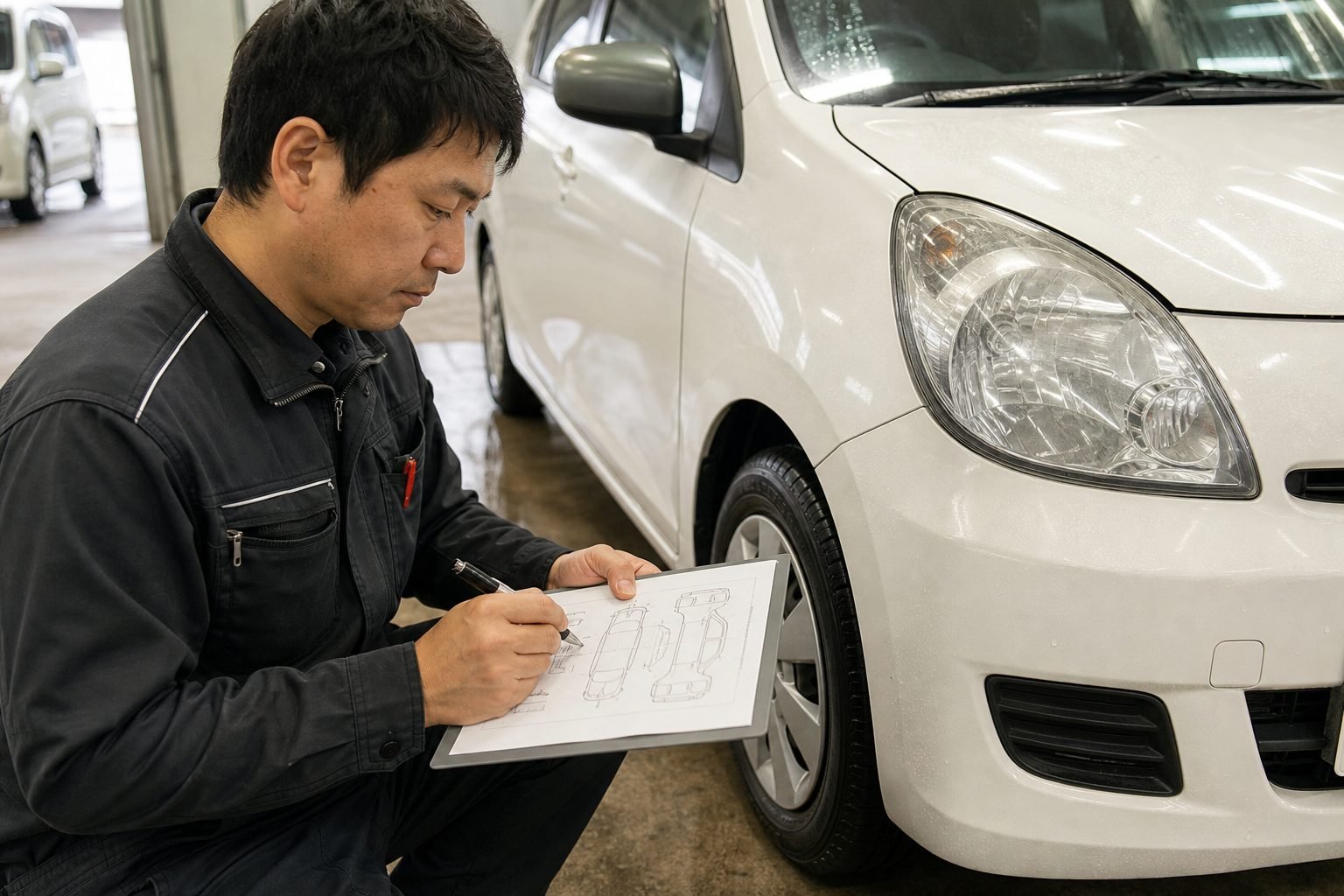
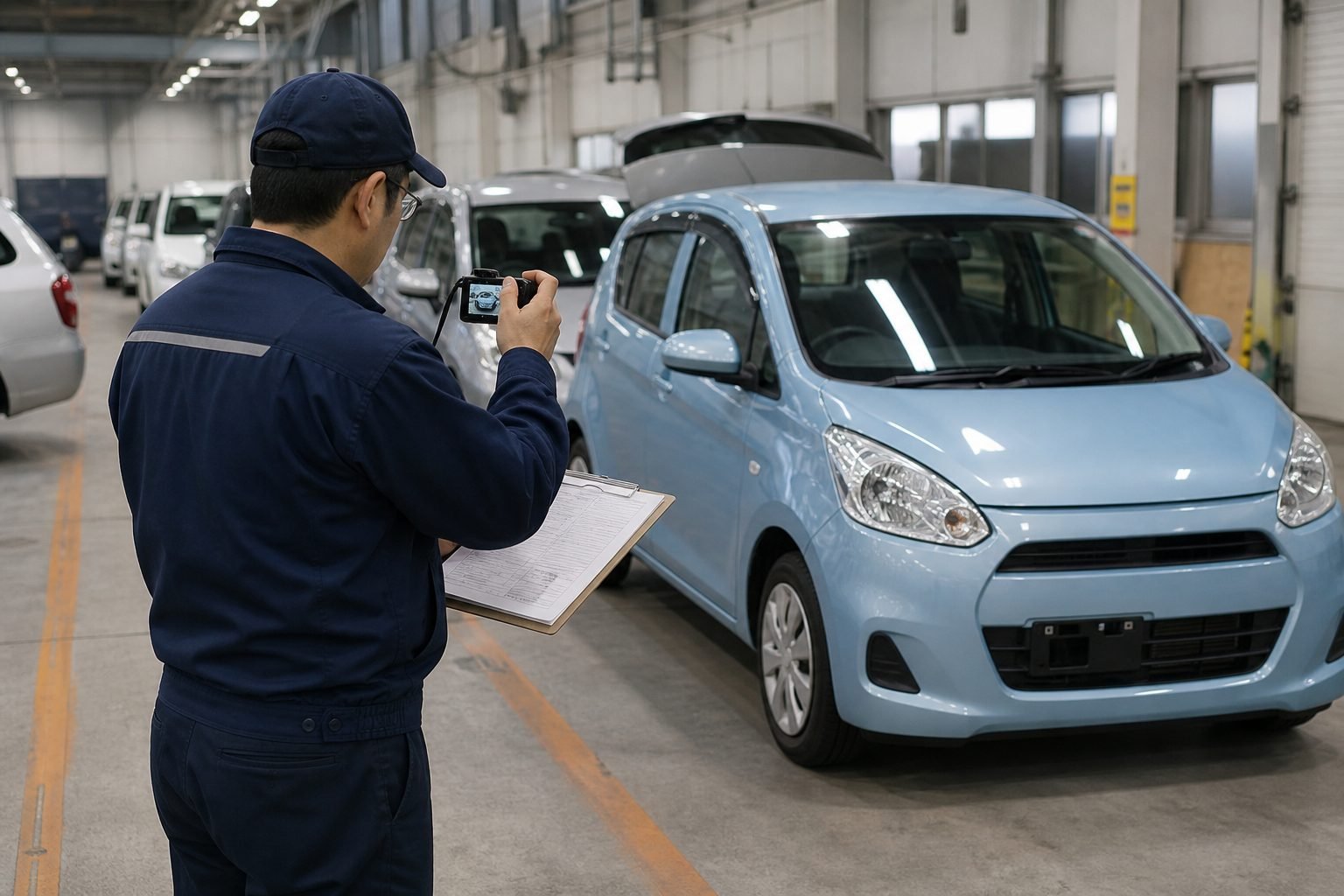
- Vehicle inspection before purchase
- Warranty options from some dealers
- Easier communication for foreigners
2. Private Sellers
Private sales are common in Japan and may offer lower prices. However, the buyer must be more careful because paperwork responsibility usually belongs to the parties involved.
Before buying privately, confirm:
- Current owner information
- Vehicle registration documents
- Vehicle tax payment status
- Shaken (車検) validity
- Accident history
3. Japanese Auto Auctions
Most Japanese auctions are wholesale markets available only to licensed dealers. Foreign residents normally cannot directly participate unless they have dealer access.
Many overseas and domestic buyers use exporters or dealers who can access auction systems.
Requirements to Buy a Car in Japan as a Foreigner
The requirements depend on the vehicle type and your personal situation.
Basic Requirements
| Requirement | Purpose |
|---|---|
| Residence Card (在留カード) | Proof of legal residence |
| Registered Address | Required for registration |
| Japanese Address Certificate | Proof of residence |
| Japanese Driving License | Required for legal driving |
| Parking Certificate (車庫証明) | Required for many regular vehicles |
| Insurance | Required before driving |
Regular Cars vs Kei Cars
Japan has two main vehicle categories:
Regular Cars (普通車)
Examples:
- Toyota Prius
- Honda Fit
- Nissan Note
- Toyota Corolla
These vehicles usually require more paperwork, including ownership transfer through the transport office.
Kei Cars (軽自動車)
Examples:
- Daihatsu Mira
- Suzuki Wagon R
- Honda N-BOX
Kei cars have a simpler registration system compared with regular cars.
However, ownership changes are still required.
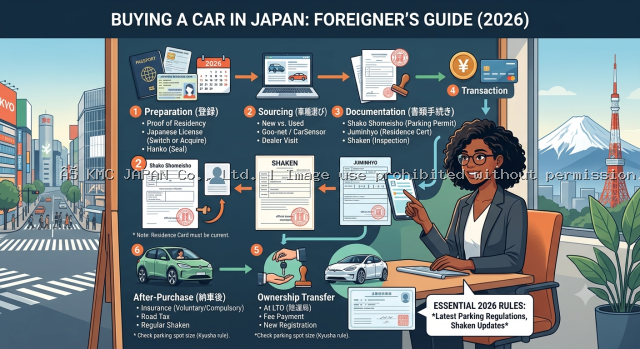
Step-by-Step Process to Buy a Car in Japan
Step 1: Choose Your Vehicle
Before purchasing, check:
- Vehicle condition
- Mileage
- Shaken expiry date
- Maintenance history
- Accident history
- Repair records
Step 2: Confirm Documents
Never purchase a vehicle without checking ownership documents.
Important documents include:
- Vehicle inspection certificate (車検証)
- Certificate of ownership information
- Maintenance records if available
- Tax payment information
Step 3: Complete Payment
After agreeing on the price, complete payment according to the sales agreement.
Step 4: Change Ownership (名義変更)
After purchasing the vehicle, the registered owner must be changed from the seller's name to the buyer's name.
This process is called:
名義変更 (Meigi Henkou)
Meaning:
Changing the registered ownership name of the vehicle.
Why Ownership Transfer Is Important
The registered owner in Japanese vehicle records is the person legally connected to the vehicle.
If ownership is not changed:
- The previous owner may still receive tax notices.
- Insurance problems can occur.
- Accident responsibility can become complicated.
- Police investigations may involve the registered owner.
- Selling the vehicle later becomes difficult.
Part 2 Coming Next
The next section will explain:
- Exact ownership transfer procedure (名義変更)
- Required documents for buyer and seller
- 車庫証明 parking certificate process
- How long ownership transfer takes
- Can you drive before transfer?
- What happens if you keep driving under previous owner's name?
- Insurance and accident risks
How to Change Car Ownership in Japan (名義変更)
After buying a used car in Japan, the vehicle ownership must be transferred from the seller's name to the buyer's name. This process is called 名義変更 (Meigi Henkou).
The ownership change officially updates the vehicle registration records held by Japanese authorities. Until this process is completed, the previous owner remains the registered owner of the vehicle.
For regular vehicles (普通車), ownership transfer is handled at the regional Transport Branch Office (運輸支局). For kei cars (軽自動車), the procedure is completed through the Light Motor Vehicle Inspection Association (軽自動車検査協会).
Timeline for Ownership Transfer in Japan
In Japan, ownership transfer should be completed promptly after purchasing a vehicle. There is no advantage to delaying the procedure because many responsibilities remain connected to the registered owner.
| Stage | Typical Time |
|---|---|
| Vehicle Purchase Agreement | Same day to several days |
| Prepare Required Documents | 1–7 days |
| Parking Certificate (車庫証明) for Regular Cars | Usually several days to about one week depending on location |
| Submit Ownership Transfer Application | Usually completed in one visit when documents are ready |
| New Registration Documents Issued | Usually same day after approval |
The exact timeline depends on your location, document preparation, and whether a parking certificate is required.
Documents Required for Ownership Transfer (普通車)
For a regular passenger vehicle, both the seller and buyer usually need to prepare documents.
Seller Documents
| Document | Japanese Name |
|---|---|
| Vehicle Registration Certificate | 車検証 |
| Transfer Certificate | 譲渡証明書 |
| Seal Certificate | 印鑑証明書 |
| Registered Seal | 実印 |
| Power of Attorney (if using agent) | 委任状 |
Buyer Documents
| Document | Purpose |
|---|---|
| Residence Certificate | Proof of Japanese address |
| Seal Certificate | Confirmation of registered seal |
| Registered Seal | Required for documents |
| Parking Certificate | 車庫証明 for many regular cars |
| Power of Attorney | If someone completes the procedure for you |
Parking Certificate (車庫証明) Explained
One of the biggest differences between Japan and many other countries is the requirement to prove that you have a proper parking space before registering many vehicles.
This certificate is called:
車庫証明 (Shako Shomei)
It confirms that you have a legal parking location for your vehicle.
Where to Apply
The application is usually submitted to the local police station (警察署) responsible for your address.
Documents Commonly Required
- Parking space application form
- Location map
- Parking area diagram
- Proof of permission from parking owner (if renting)
- Proof of ownership if you own the parking area
Kei cars may have different requirements depending on the municipality. Some areas require parking notification while others may not require it.
Can You Drive the Car Before Changing Ownership?
Many foreigners ask whether they can immediately drive a car after buying it while keeping the previous owner's name on the registration.
The answer depends on the situation, but continuing to drive without completing proper procedures creates risks.
A vehicle can sometimes be temporarily driven while paperwork is being processed, provided that:
- The vehicle has valid shaken (車検).
- Compulsory insurance (自賠責保険) is valid.
- Optional insurance coverage is arranged correctly.
- You have permission from the owner.
- The vehicle is legally operated.
However, delaying ownership transfer for a long period is strongly discouraged.
Problems If You Fail to Change Ownership
Driving a vehicle without completing ownership transfer can create several serious problems.
1. Vehicle Tax Problems
Annual automobile tax notices are connected to the registered owner.
If the vehicle remains under the previous owner's name:
- The previous owner may receive tax notices.
- Disputes may occur between buyer and seller.
- The previous owner may request cooperation to correct the situation.
2. Accident Responsibility Problems
If an accident occurs, investigators may first contact the registered owner shown in government records.
This can create confusion about:
- Who was driving?
- Who had possession of the vehicle?
- Who was responsible for insurance?
3. Insurance Problems
Vehicle insurance must correctly reflect the actual user and owner situation.
If you drive a vehicle while insurance information is incorrect:
- Insurance claims may become complicated.
- The insurer may investigate the circumstances.
- Coverage issues may occur depending on the policy conditions.
4. Difficulty Selling the Vehicle Later
A vehicle registered under another person's name cannot easily be sold or exported without cooperation from the registered owner.
Future problems may include:
- Finding the previous owner years later.
- Obtaining required documents.
- Delays in export procedures.
What Happens If Police Stop You?
During a traffic stop, police may check:
- Driver's license
- Vehicle registration
- Insurance status
- Vehicle inspection validity
If the vehicle ownership situation appears unusual, police may ask questions and request supporting documents showing that you legally purchased or use the vehicle.
A delayed ownership transfer itself does not automatically mean a criminal offense in every situation. However, ignoring registration requirements or intentionally avoiding legal procedures can create legal problems.
Does Ownership Transfer Affect Your Visa?
A common concern among foreigners is whether failing to change car ownership can directly affect their Japanese visa.
The important point is:
A simple delay in vehicle ownership transfer does not automatically cancel or revoke a visa.However, immigration authorities consider a person's overall compliance with Japanese laws and regulations during certain immigration procedures.
Problems may become more serious if a person:
- Commits repeated legal violations.
- Uses false documents.
- Engages in fraud.
- Ignores official orders or penalties.
- Has serious criminal convictions.
For normal situations, such as a genuine ownership transfer delay that is corrected properly, it is unlikely by itself to become a visa issue.
Next: Part 3
The final part will cover:
- Driving an uninsured or illegally registered vehicle
- Penalties for vehicle-related violations in Japan
- Car export rules for foreigners leaving Japan
- Buying a car before leaving Japan
- Best practices for foreign residents
- FAQ section
- FAQ Schema JSON-LD
- SEO internal linking strategy
- Final conclusion
What Happens If You Drive a Car Without Proper Insurance?
In Japan, every vehicle must have compulsory automobile liability insurance called 自賠責保険 (Jibaiseki Hoken). This insurance is required by law and covers basic compensation for injuries caused to other people.
However, compulsory insurance alone is usually not enough. Most drivers also purchase voluntary insurance called 任意保険 (Nini Hoken) because accident costs can be much higher than compulsory coverage limits.
Risks of Driving Without Proper Insurance
- You may have to personally pay compensation after an accident.
- Medical costs and damages can become extremely expensive.
- You may face legal consequences depending on the situation.
- Future insurance applications may become more difficult.
Before driving any newly purchased vehicle, confirm that both the compulsory insurance and your personal insurance arrangements are valid.
Driving a Vehicle That Is Still Registered Under the Previous Owner
Some foreigners purchase a vehicle from a friend, colleague, or private seller and continue driving it without completing 名義変更.
Although this situation may happen temporarily, keeping the vehicle under another person's name for a long period creates unnecessary risks.
Possible Problems Include:
| Problem | Possible Result |
|---|---|
| Traffic violations | Communication problems because official records show another owner |
| Vehicle tax notices | Previous owner may receive tax bills |
| Accident | Insurance and ownership investigation may become complicated |
| Vehicle sale/export | Previous owner's documents may be required |
| Dispute with seller | Difficult to prove current ownership situation |
The safest approach is to complete ownership transfer immediately after purchase.
What If the Previous Owner Refuses to Cooperate?
A common problem occurs when a buyer purchases a vehicle but delays the ownership transfer. Later, the previous owner cannot be contacted or refuses to provide documents.
This can create major difficulties because many procedures require cooperation from the registered owner.
Possible Problems:
- Unable to complete ownership transfer.
- Unable to sell or export the vehicle easily.
- Difficulty replacing lost documents.
- Additional administrative procedures may be required.
Always complete 名義変更 while both parties are available.
Buying a Car Before Leaving Japan
Many foreigners buy cars in Japan and later leave the country. This situation requires careful planning.
If You Leave Japan Permanently:
- Sell the vehicle before departure.
- Export the vehicle overseas.
- Complete deregistration procedures.
- Transfer ownership to another person.
Do not simply leave the vehicle behind. The registered owner remains connected to the vehicle records.
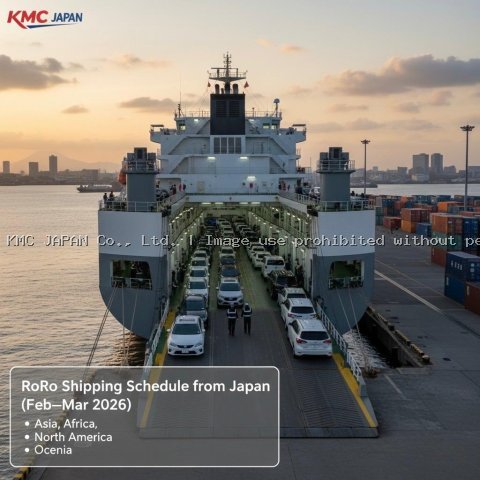
Can Foreigners Export Their Japanese Car?
Yes. Foreign residents can export vehicles from Japan if they complete the correct export procedures.
The process usually includes:
- Preparing export documents.
- Arranging shipping.
- Completing deregistration procedures.
- Submitting required paperwork.
A vehicle that is still registered in Japan cannot simply be shipped overseas without proper procedures.
Common Mistakes Foreigners Make When Buying Cars in Japan
1. Buying Without Checking Documents
Always confirm ownership documents before payment.
2. Ignoring Shaken Expiry Date
Vehicle inspection costs can be significant. Check whether the vehicle has valid 車検 before purchase.
3. Not Checking Insurance
Never assume the previous owner's insurance automatically covers you.
4. Delaying Ownership Transfer
The longer you delay, the more problems can appear.
5. Buying a Vehicle You Cannot Register
Before purchase, confirm that you can complete registration using your current address and documents.
Best Practices for Foreign Car Owners in Japan
- Complete ownership transfer immediately after purchase.
- Keep copies of all purchase documents.
- Maintain valid insurance coverage.
- Pay vehicle taxes on time.
- Keep your residence information updated.
- Maintain service records.
- Follow Japanese traffic regulations.
Frequently Asked Questions (FAQ)
Can foreigners buy used cars in Japan?
Yes. Foreign residents can buy and own cars in Japan if they meet registration requirements and have the necessary documents.
Do foreigners need a Japanese driving license to buy a car?
Buying and driving are separate matters. To legally drive in Japan, you need a valid Japanese driving license or an officially recognised international driving permit depending on your situation.
How long does car ownership transfer take in Japan?
When all documents are prepared, ownership transfer can often be completed in one visit to the relevant registration office. Preparation time depends on obtaining documents such as parking certificates.
What is 名義変更 (Meigi Henkou)?
名義変更 means changing the registered owner name of a vehicle in Japanese government records after a sale or transfer.
Can I drive a car before changing ownership?
Temporary use may occur in some situations, but delaying ownership transfer creates risks involving taxes, insurance, and legal responsibility.
Will my visa be cancelled if I forget to change car ownership?
A simple ownership transfer delay does not automatically cancel a visa. However, serious or repeated violations of Japanese laws, fraud, or criminal matters may affect immigration decisions.
Can I export my Japanese car when I leave Japan?
Yes. Foreign residents can export vehicles after completing the required deregistration and export procedures.
FAQ Schema JSON-LD
KMC JAPAN Car Buying & Ownership Support Fees (2026)
Buying a car in Japan involves more than finding a vehicle. Foreign residents may need support with vehicle selection, auction purchasing, ownership transfer, parking certificates, and export procedures.
KMC JAPAN provides professional assistance for foreigners living in Japan and international customers who want to purchase Japanese vehicles safely and complete all required procedures correctly.
| Service | Starting Fee | Details |
|---|---|---|
| Car Search & Purchase Support | From ¥30,000 + tax | Vehicle search, advice, document checking, purchase assistance |
| Japanese Auction Buying Support | From ¥50,000 + tax | Auction access, auction sheet explanation, bidding support, purchase management |
| Kei Car Ownership Transfer (軽自動車 名義変更) | ¥15,000 + tax | Ownership change procedure and registration support |
| Regular Car Ownership Transfer (普通車 名義変更) | ¥25,000 + tax | Transport office procedure, document preparation, registration support |
| Parking Certificate Support (車庫証明) | From ¥15,000 + tax | Application preparation and police station procedure assistance |
| Vehicle Inspection Support | From ¥10,000 + tax | Vehicle condition checking, maintenance history review, inspection arrangement |
| Japanese Car Export Processing | From ¥50,000 + tax | Export documents, deregistration support, shipping coordination |
| Complete Foreign Resident Support Package | From ¥50,000 + tax | Vehicle purchase, paperwork, ownership transfer, and delivery assistance |
Note: Government fees, transportation costs, parking certificate charges, insurance costs, vehicle taxes, recycle fees, shipping fees, and destination country import charges are not included unless specifically mentioned.
Contact KMC JAPAN before purchasing a vehicle to avoid registration problems, unexpected costs, and paperwork issues.
How much does KMC JAPAN charge for car buying support?
KMC JAPAN service fees start from ¥30,000 + tax for vehicle purchase assistance. Additional services such as auction buying, ownership transfer, parking certificate support, and export processing have separate fees depending on the customer's requirements.
Conclusion
Buying a car in Japan as a foreigner is a straightforward process when you understand the rules and complete the correct paperwork.
The most important step after purchasing a vehicle is completing ownership transfer (名義変更). This protects both the buyer and seller by ensuring government records, taxes, insurance, and legal responsibilities match the actual owner.
Driving a vehicle without changing ownership may seem convenient, but it can create serious problems in the future, especially during accidents, insurance claims, resale, or export.
Foreign residents who follow Japanese regulations, maintain proper insurance, and complete registration procedures can enjoy safe and trouble-free vehicle ownership in Japan.
KMC JAPAN Support
KMC JAPAN helps customers understand Japanese vehicles, auction systems, ownership procedures, and vehicle export processes.
Whether you are buying a car in Japan for personal use or exporting Japanese vehicles overseas, our team provides professional guidance based on Japanese automotive experience.
Choose the right vehicle, complete the correct paperwork, and enjoy your Japanese car with confidence.